You are having one of those regular hauling days, and the road ahead looks promising both literally and professionally. Now, what happens if you get stranded on the side of the road with a flat tire?
It is a hassle, and you’re probably wondering how to escape this troubling scenario.
One of the most suitable outcomes is to replace your trailer wheels, which brings us to the concept of trailer wheel bolt patterns.
Trailer wheel bolt patterns are the number of bolts present on each wheel. It also refers to the diameter of the circle on which the blots are arranged.
Finding the correct bolt pattern is simple, and it is crucial to ensure the measurements are accurate. It helps you determine the safety, compatibility, and capacity of your trailer.
Most of the trailers come with a 4, 5, or 6 Lug pattern. There is a range of combinations used for connecting the wheels on the trailer.
In this blog, we will delve into understanding trailer wheel bolt patterns and how to identify them. We will further discuss its significance, the different pattern sizes, common mistakes to avoid, and essential tips to follow.
Start reading!
Understanding Wheel Bolt Patterns
So, what is the lug pattern? A bolt pattern is also known as a wheel bolt pattern or lug pattern. It defines the arrangement and number of bolts used to attach a wheel to the hub of a vehicle.
You must be well aware of the bolt patterns or lug patterns of the wheel to replace the hub on your trailer.
The trailer tire bolt pattern is characterized by the count of bolts or lugs used for each wheel. It also depends on the diameter of the circle formed due to the arrangements of the bolts.
Identifying the bolt pattern is quite simple and requires precise measurements. Most of the boat trailers on the road feature a 4, 5, or 6 lug arrangement.
A typical term for boat trailer hubs is five on 4-1/2 or simply 545. It shows that the hub contains five bolts evenly distributed on a 4-1/2″ circle.
It is expressed in two numbers:
- The first indicates the number of bolts
- The second represents the diameter of the circle that those bolts form
When choosing new wheels for your trailer, having a detailed understanding of bolt patterns is beneficial. Bolt patterns guarantee that your wheels will attach firmly to the vehicle.
Terms Used for a Bolt Pattern
Understanding the different terms related to bolt patterns is necessary for those involved in mechanical assemblies, automotive wheels, or construction work.
The essential terms related to bolt patterns help you understand technical conversations. You will be able to make informed choices while choosing the suitable bolt pattern.
Here are some of the key terms:
- Bolt Pattern —It is the arrangement of holes, or the specific combination of holes and positions. It is vital for the bolts securing the wheel to the axle. It includes the number N of bolts.
- Bolt Hole Size — It refers to the dimensions of the holes where the bolts go through, or the size of the bolts themselves. The holes are larger than the actual diameter of the bolt.
- BCD, or Bolt Circle Diameter —The diameter of the circle formed by the bolts surrounding the wheel’s center is referred to as the BCD, or Bolt Circle Diameter.
- Hub Diameter —It refers to the dimension of the hub, or the dimension of the opening at the center of the wheel. The axle hub fits through this opening when the wheel is attached.
- Distance Between Bolts —It is the measurement of the space from the center of one bolt to the center of the following bolt. That is also referred to as “center-to-center” or the distance between adjacent bolts.
Other essential terms you must know when selecting new wheels or discussing fitment with professionals:
- Lug Pattern: It highlights the lug bolts that fasten the wheel.
- Trailer Rim Lug Pattern: It focuses on the rim design of the wheel.
- Pitch Circle Diameter (PCD): It is a technical term used to define the diameter of the circle through the bolt holes.
How to Identify a Wheel Bolt Pattern?
The initial step to identify a wheel bolt pattern is to count the number of bolt holes on the wheel. This number is crucial in determining the initial part of the bolt pattern specification. You can examine the wheel visually, looking for the spots where the bolts or lug nuts connect.
Generally, most of the wheels will feature 4, 5, 6, or 8 bolt holes. It varies based on the vehicle’s brand and model.
It ensures a precise count that establishes the basis for effectively measuring the bolt circle diameter. It enhances compatibility when choosing new wheels for your vehicle.
First, you must count how many lug bolts are present on a single wheel. The majority of trailer hubs feature 4 or 5 lugs for each wheel/hub. Dump trailers designed for heavier loads and higher capacities feature 6 or 8 lugs on each wheel.
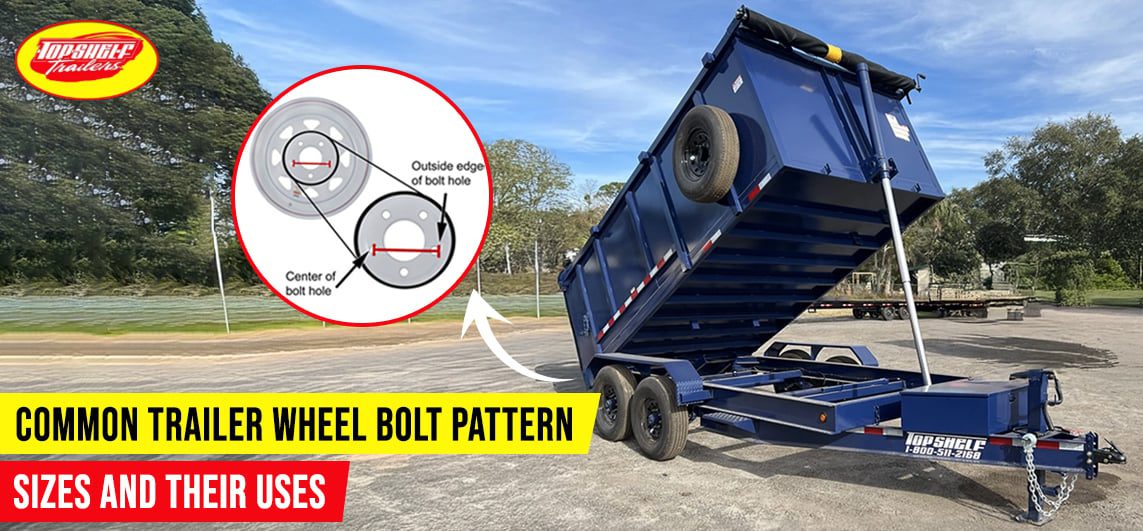
If the trailer hubs have an equal number of bolts securing the wheel, use a ruler, tape measure, or caliper. It will help you measure from the center of one bolt to the center of the bolt that is directly opposite.
The hub lug bolt configuration will be established by the number of lug bolts and the spacing between the opposite hubs. Every trailer tire lug pattern, except for the 5 lug ones, is measured in this way.
In the case of 5 lug bolts, the measurement process changes slightly. Choose a lug bolt and determine the measurement from the rear of one lug to the center of the opposing one.
Make sure to leave out one bolt when taking measurements. The distance can be measured in both directions.
The two most popular lug patterns are 4 on 4″ and 5 on 4-1/2″ hubs. These hubs are commonly found on smaller boats and utility trailers.
Why is the Trailer Wheel Pattern Essential?
The wheel bolt configuration on a trailer is one of the most essential elements, ensuring secure and hassle-free towing.
A proper bolt pattern ensures that the wheels fit tightly, align correctly with the axle, and support the weight of your trailer. Neglecting this crucial factor might result in compatibility problems and wear and tear.
It potentially leads to hazardous conditions while driving. Understanding the importance of bolt patterns is the initial step in making knowledgeable choices for your trailer’s upkeep and improvements.
Here we will discuss why a proper trailer wheel lug pattern is beneficial:
1. Dangers Involved
A wrongly fit rim bolt pattern can impact wheel stability. It causes vibrations, irregular tire wear, or even wheel disconnection while driving. Correct alignment ensures wheels are firmly connected, upholding vehicle safety.
2. Enhances Performance
Correct wheel fitment improves handling, steering response, and overall vehicle performance. Precise bolt pattern measurement ensures proper wheel installation, facilitating uniform tire wear and increasing tire longevity.
3. Compatibility Challenges
Disorganized bolt patterns cause installation difficulties. It necessitates extra adjustments or adapters, impacting vehicle integrity. Confirming the proper wheel bolt specifications facilitates smooth installation and peak performance.
4. Improves Aesthetics
Bolt patterns affect the aesthetic appearance of your vehicle. Choosing wheels that match the correct bolt pattern improves their look.
5. Trailer Wheel Bolt Pattern Sizes
Understanding the different wheel lug dimensions is crucial while choosing wheels for your vehicle. The commonly used bolt patterns among various vehicle types and the factors that contribute to these differences are discussed.
Let us understand how to measure bolt pattern and learn their sizes
1. 4 lug bolt patterns: Common in Compact Cars
4-lug patterns like 4x100mm are commonly seen on small and subcompact vehicles. The “4” denotes four lug holes, while “100mm” signifies the diameter of the circle created by them. This setup is ideal for lighter vehicles where fewer lugs are adequate to secure the wheel properly.
4Lug Bolt Pattern Conversions (mm to Inches)
| 4-98mm→4-3.86” | 4-100mm→4-3.94” | 4-108mm→4-4.25” | 4-110mm→4-4.33” | 4-114.3mm→4-4.5” |
2. 5 lug trailer bolt pattern: Standard in Many Sedans and SUVs
5-lug patterns are the most common, found on numerous sedans, SUVs, and light trucks. The measurements comprise 5×114.3mm (equal to 5×4.5 inches).
The extra lug offers enhanced strength and stability, supporting the heavier weight and performance requirements of these vehicles.
5-Lug Bolt Pattern Conversion (mm to Inches)
| 5-98mm→5-3.86” | 5-100mm→5-3.94” | 5-108mm→5-4.25” | 5-110mmć5-4.33” | 5-112mm→5-4.41” |
| 5-114.3mm→5-4.5” | 5-115mm→5-4.52” | 5-120mm→6-4.72” | 5-120.7mm→5-4.75” | 5-127mm→5-5” |
| 5-130mm→5-5.12” | 5-135mm→5-5.3” | 5-139.7mm→5-5.5” | 5-150mm→5-5.91” | 5-155mm→5-6.1” |
| 5-165.1mm→5-6.5” | 5-205mm→5-8.07” |
3. 6 lug trailer wheel bolt pattern: Typically found in Trucks and Larger SUVs
Full-size trucks and larger SUVs often use 6-lug patterns, such as 6×139.7mm (6×5.5 inches). This configuration provides enhanced load-bearing strength, crucial for vehicles intended to transport heavy cargo or tow significant weights.
6-Lug Bolt Pattern Conversion (mm to Inches)
| 6-114.3mm→6-4.5” | 6-115mm→6-4.52” | 6-115mm→6-4.52” | 6-132mm→6-5.2” | 6-135mm→6-5.3” |
| 6-139.7mm→6-5.5” |
4. 8-Lug Patterns: Used in Heavy-Duty Vehicles
Standard on heavy-duty trucks and commercial vehicles is an 8-lug pattern, including 8×165.1mm (8×6.5 inches). The increased quantity of lugs helps spread the significant weight and pressures these vehicles face, guaranteeing longevity and safety.
8-Lug Bolt Pattern Conversion (mm to Inches)
| 8-165.1mm→8-6.5” | 8-170mm→8-6.69” | 8-200mm→8-7.87” |
6. Trailer Wheel Pattern Uses
The bolt pattern of a trailer wheel is a key factor that determines how well your trailer handles the road. It also explains how safely it carries loads and what kind of towing functions it is suited for.
Here we will discuss the primary uses and considerations for trailer wheel bolt patterns:
1. Pairing the Right Axle and Hub:
Every bolt pattern is created to accommodate specific axles and hubs. Utilizing the incorrect pattern results in poor fitment, leading to vibrations, irregular wear, or hazardous wheel separations. You must verify your trailer’s specifications or consult the manufacturer before changing wheels.
2. Load Capacity and Strength:
Larger trailers, such as those used for transporting boats, livestock, or construction machinery, require wheels with additional bolts.
These designs allocate weight more uniformly, enhancing durability and security for substantial loads. In comparison, lighter utility trailers typically feature 4-lug or 5-lug wheels, adequate for smaller cargo and simpler to maneuver.
3. Compatibility and Replacement:
Knowing your trailer’s bolt pattern helps you simplify the process of locating replacement wheels and tires. It is mainly applicable during urgent situations.
Standardized designs enable you to procure components swiftly from nearby vendors. It minimizes downtime and eases stress while traveling.
4. Upgrading and Customizing Trailer Tire Bolt Pattern:
If you want to enhance the trailer’s look or functionality, start by focusing on the wheels. Understanding the bolt pattern expands possibilities for custom wheels. It also helps in making better tire selections and increasing off-road potential for adventure trailers.
5. Safety and Legal Compliance:
Recognizing the uses and importance of trailer wheel bolt patterns, you can make an informed choice. Now, you can choose wisely, considering the trailer’s performance, safety, and adaptability.
How Bolt Pattern Determines Your Trailer’s Towing Capacity?
The wheel bolt pattern on your trailer does not provide an accurate weight capacity. It can help you refine options and give a specific estimate of your trailer’s maximum towing capability.
For instance, if you have 6 bolts, it is likely not a 7,000-lb axle. Most of the axles with that capacity feature 8 lugs.
A properly matched bolt pattern ensures that the wheels are securely attached to the hub, minimizing the risk of loosening or failure under heavy loads.
Consider that the bolt pattern may be too small or not match the trailer’s specifications. It can create weak points where stress is concentrated. It increases the chances of mechanical failure during towing.
Larger bolt patterns with more bolts or a wider diameter typically allow for better weight distribution and higher towing capacities. This is because additional bolts share the load more evenly, reducing the strain on each bolt and on the wheel hub itself.
As a result, trailers designed for heavy-duty towing often feature more robust bolt patterns to accommodate greater forces during transit.
Common Mistakes to Avoid While Measuring Bolt Patterns
Although measuring wheel size might appear simple, it is not. It is crucial to avoid various typical errors to guarantee precision and dependability.
- A frequent error is taking measurements from the tire sidewall rather than the wheel rim. It potentially causes inaccurate measurements and compatibility problems.
- Neglecting essential elements like wheel offset and bolt pattern may lead to incorrect fitment and possible safety risks.
- Utilizing the appropriate measurement units and instruments is crucial when determining wheel size for accuracy and uniformity.
- Avoiding these typical errors, you can accurately determine wheel size and choose the ideal aftermarket wheels for your car.
Here are some tips to overcome common challenges:
- Measurement Challenges: If you are having problems getting accurate measurements, it is advised to utilize a digital caliper or seek assistance from a professional.
- Worn Studs or Bolt Holes: In older trailers, the lug holes could be worn, complicating measurement tasks. You can even contrast with a new or less-used component.
- Mismatched Wheels: If you are unsure whether the wheel fits your stud pattern, consult a professional before installing. Incompatible wheels can pose a risk.
- Match the Bolt Pattern: The replacement wheels should possess a bolt pattern matching the vehicle’s current setup.
- Consider Hub Bore Size: The wheel’s central opening must correspond with the vehicle’s hub size to ensure correct alignment and avoid vibrations.
- Verify Offset and Backspacing: These dimensions influence the position of the wheel in relation to the suspension and fenders. Inaccurate specifications may cause clearance problems.
Practical Tips for Drivers for Choosing the Right Trailer Wheel Bolts
Choosing the lug bolts or studs to the specified stud size and pattern of the vehicle is essential. Generally, drivers refer to their vehicle’s manual or a reliable automotive source for precise details.
Here are some of the essential tips for drivers to follow:
1. Choosing the Correct Lug Bolts and Nuts
It is essential to align the lug bolts or studs with the vehicle’s designated stud size and stud configuration. Drivers must refer to their vehicle’s manual or a reliable automotive source for precise details.
Here is a checklist for selecting the correct hardware:
- Stud Pattern: Determine the diameter of a conceptual circle created by the wheel lugs.
- Lug Bolts/Nuts Size: Verify that the thread size corresponds with the vehicle’s stud dimensions.
- Seat Type: The contact area may be conical, spherical, or flat. This ought to correspond with the wheel.
- Length: Bolts or studs should be sufficiently long to engage the threads properly.
2. Maintaining Bolt Pattern Integrity
It requires frequent examinations and correct procedures to avoid harm and uphold the bolt pattern.
Torque Setting: Drivers can use a calibrated torque wrench to secure lug nuts according to the manufacturer’s specified guidelines.
Cross Pattern Tightening: While fastening the wheel, switch between opposing bolts, ensuring uniform pressure distribution.
By following these recommendations, drivers will guarantee the dependability and security of their wheel attachment. Correct maintenance of lugs and bolts is a simple yet essential part of vehicle care.
3. Advanced Bolt Patterns
Understanding the advancements of wheel bolt patterns is crucial. It enhances vehicle performance and handling characteristics. Changes and design decisions in this field have significant consequences for regular drivers and performance fans.
4. Tailored Bolt Patterns for Performance
Generally, manufacturers provide vehicles featuring a 4-lug bolt pattern, known as 4×100. This pattern indicates four bolts arranged in a circle with a diameter of 100 mm. Adjusting a vehicle’s bolt pattern leads to substantial improvements in performance.
Drivers should be aware that changing the bolt pattern is not an easy job; it necessitates new hubs, wheels, and frequently, alterations to the brake system.
Enhance the Trailers’ Excellence with Wheel Lug Pattern with Top Shelf Trailers!
Measuring your car’s wheel bolt pattern is crucial for choosing wheels. It fits correctly and improves the aesthetics and functionality of your vehicle.
Understanding the fundamentals of bolt patterns, using accurate measuring instruments, and verifying your measurements are crucial steps. You can avoid frequent mistakes and guarantee compatibility.
Dedicating time to measure lug pattern accurately guarantees a smooth fit that improves your driving experience.
So, are you ready to enhance your ride? Top Shelf Trailers is here to help you find the ideal wheel bolt pattern according to your wheel’s requirements. It improves your vehicle’s performance, which is distinct on every road.
We will help you change a trailer tire safely and efficiently and implement the right wheel lug pattern. Our trailer experts provide the ideal tools and source the finest trailer components tailored to your needs.
FAQs
1. How do you measure a 5-lug bolt pattern?
Select any lug hole as a starting point to measure a 5-lug bolt pattern. Measure from the outer edge of this hole to the center of the lug hole directly across from it. This measurement corresponds to the diameter of the imaginary circle passing through the center of all lug holes.
2. How can I determine my wheel’s bolt pattern?
First, you must count the number of lug holes on your wheel. Then, measure the distance between the centers of two opposite lug holes or use the method described above for 5-lug patterns. It will give you the bolt pattern, as the number of lugs followed by the diameter.
3. What does a 4×137 bolt pattern signify?
A 4×137 bolt pattern indicates that the wheel has four lug holes arranged in a circle with a diameter of 137 millimeters. This specification is essential for ensuring proper wheel fitment on your vehicle.
4. What is the meaning of a 4×100 bolt pattern?
A 4×100 bolt pattern means the wheel has four lug holes positioned on a circle with a 100-millimeter diameter. This pattern is typical in many compact cars.
5. What is the most common 5-lug bolt pattern?
The 5×114.3mm (also known as 5×4.5 inches) bolt pattern is among the most prevalent 5-lug configurations, commonly found on various cars and SUVs.
6. How do I measure bolt size?
Determine the diameter, thread pitch, and length to measure bolt size. Use a caliper to measure the diameter, count the number of threads per inch, and measure the length from the base to the tip.